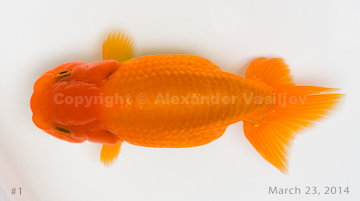
HIGH RANCHU MON

HIGH RANCHU MON
Art by Alexander Vasiljev, Copyright © 2020

HIGH RANCHU STORE - AZAYAKA RANCHU FOOD

Showing posts with label Tosai. Show all posts

Saturday, October 28, 2017

A WAY TO RAISE RANCHU ● GROOMING KUROKO AND TOSAI

Defining Body Parts

The main body parts are identified as follows: head is from mouth to the edge of the gill cover, body is from gill cover to the vent below tail. The environment and grooming techniques will have a big impact on developing ranchu head, body and tail.

For body part names please refer to this article.


Building Ranchu Foundation

There is an old Japanese saying “Good ranchu head is created before the color change”. For the head-growth to develop properly, it needs a good scull structure, as a foundation. A good foundation must be selected and formed in kuroko before the change of color. During this time it is important to achieve balanced Dragon or Lion Head (more about ranchu standards here). 

If any combination of head-growth below occurs, the head will appear unbalanced:
  • growth on the top of the head, no growth on the gill plates 
  • growth evenly develops over the entire head  
  • growth develops on cheeks and under eyes only 
Delays in water changes help to suppress active fish movement and aids in developing head-growth at an early stage.

To Promote Head-Growth Development

Food is very important in developing head-growth. Feeding protein reach diet is a must. Silkworms, earthworms, bloodworms (can be frozen) are all high in protein and effective. Genetic background is also important.

Suggestions on promoting head-growth development:
  • feed plankton, bloodworms, green water 
  • reduce water changes to suppress movement 
  • make sure the body develops properly 
Pond depth is not known to effect head-growth development. To develop a good ranchu, balancing of the whole body and head must be achieved, and not just the head-growth.


To Promote Funtan (cheeks)

Feeding bloodworm and green algae will help in developing funtan. Suppress movement by extending intervals between the water changes and raising ranchu in green water.


To Promote Body & Head Development

It is important to develop a good skeleton in kuroko before the color change. Good balance between the head and body is very important. Preference should be given to longer bodies with wide back and peduncle, which will balance well with the size of the head.

To make back wider and increase the width between the eyes:
  • feed enough 
  • use green water 
  • slightly increase the stocking density to suppress active movement 
Beware that with increased stocking density vertical body growth will be suppressed.


How to Make Good Back

Water depth is very important in formation of a good back shape in fry. There is an old Japanese saying “Shallow water gives gently curved back, deep water gives round back” makes a good point. 

Water depth at 4 in (10cm) during the fry development produces gently curved back, while water depth around 3.3 ft (1m) gives more rounded shape. Genetics are also important in developing the right back.


Tail Tension

Tail shape is very important and is greatly dependent on grooming technique. However, if you only pursue creating a good tail, you will loose on fish health and overall quality. It is a trade-off to make a good tail and to keep fish health. It is difficult to do and one has to find a balance.

Factors that loosen tail tension:
  • weak tail shoulders 
  • excessive exercise 
  • large pond size
  • pond with no shade or over shaded 
  • strong aeration 
  • often water changes 
  • appropriate or slightly lower stocking density 
Factors that improve tail tension:
  • strong tail shoulders 
  • less exercise 
  • small pond size
  • pond with sun/shade balance 
  • weak aeration 
  • use of green water 
  • high or low stocking density 


Making a Good Tail Before the Color Change

To create a good tail, you must select kuroko with tail shoulders that are open at 160-180° and have a strong tail core.


To make a tail shoulder curve like in a bow (bow and arrow), the fish must swim moderately to finish formation before the color change. If the curve increases it may result in weak tension and possible collapse of the tail shoulders.


Making the Tail Core

Water depth will effect the tail core in fry. The depth at 4 in (10cm) during development is necessary. There is a tendency for the tail core either to fall lower if the water depth is too shallow or rise up if the depth is too deep.

After the tail is formed and the core is established in kuroko stage, it is not effected as much by the water depth. Still, as a general rule, it is a good idea to keep the water depth at 6-8 in (15-20cm) during ranchu development. Also, increased exercise may result in softening of the tail core, as well as loss of the tail tension.

_________________________________________________________________________________

Links to published chapters:

● INTRODUCTION
● WATER
● NOTES ON GREEN WATER & WATER CHANGE
● WATER TEMPERATURE
● AERATION
● SUNLIGHT AND SHADE
● CONTAINERS FOR RAISING RANCHU
● FOOD
● FEEDING REGIMENT
● BREEDING & SPAWNING
● RAISING & GROOMING FRY
● GROOMING KUROKO AND TOSAI
● CULLING
● SELECTION METHODS
● CULLING ROUND - I
● CULLING ROUND - II
● CULLING ROUND - III
● CULLING ROUND - IV
● CULLING ROUND - V
● FORSEEING RANCHU CHANGES IN THE FUTURE

_________________________________________________________________________________


Monday, July 10, 2017

HIGHRANCHU TIMELINE - ONE FISH'S JOURNEY - PART II

Presenting my next ranchu - male fish study from TOSAY to current OYA, hatched on April 14, 2014. I really like this fish. Since it was CBR it displayed very neat scales - small, consistent and well placed.


Little over 3 months old. Photographed on July 28, 2014

Little over 5 months old. Photographed on September 27, 2014

Little under 1 year and 7 months old. Photographed on November 2, 2015

Little under 3 years and 3 months old. Photographed on July 5, 2017


COMMENTS

Currently a beautiful OYA fish of 6 in (15.25 cm) long. The body isn't changing much throughout the years. Elongated shape and overall outline is what I was trying to feature in this ranchu. The tail has no visible change as well, and maintained is coloration. The head, on the other hand, is changing. Its definitely widened but still slightly underdeveloped. The body color pattern somewhat changed. Body has lost a few "Azuki Bean" scales on either side. The head color pattern changed as well, from Ichimonji-aka or Red Straight Line to Kuchibeni or Lipstick, red outlined mouth.

Please feel free to post your own comments.


Monday, February 9, 2015

VISION OF A PERFECT RANCHU

As I learn about ranchu standards and grooming techniques, I train my eye to recognize qualities of a good ranchu. In Japan, each ranchu master works on its own line (bloodline) that will ultimately reflect the master's vision for a "perfect" ranchu. Through a scrupulous process of selection, the breeder seeks fish that carries one or several desired qualities. By carefully selecting parent fish with such qualities and breeding them, followed by many years of selection, the goal can be reached. It truly is a "living sculpture".

A preference for my own "perfect" ranchu is now more clear. My vision is shaped by studying the many looks of ranchu and recognizing what is most pleasing to my eye. These are as follows (looking at the ranchu from above):
  • long rectangular body outline
  • rectangular head outline with funtan slightly protruding on the right and left of the head (I call it a hammer shark look)
  • not much headgrowth development on top of the head
  • thick tail peduncle and bracelet
  • triangle shaped tail with supportive shoulders, that are only gently curved, with side lobe tips curved slightly more
  • when swimming the tail must take a rounder shape and return to its original shape when fish isn't moving
  • small uniform scales
  • bright reds

Early bloomers might not look as good at an older age, with their headgrowth overdeveloped, ruining the overall balance. Vise versa, those not fully developed tosai can turn into a beautiful fish when older.

All of the above must be in balance. Proportions between head, body and tail are very important and rely on personal perception. I am very interested in creating a ranchu that blossoms slowly, reaching its desired shape by the end of nisai and maintaining that look through its oya years. This, in my opinion helps to raise a healthier fish, that can live longer. In most cases, ranchu that are judged at the All Japan Ranchu Show, are groomed for a specific age category - tosai, nisai or oya. In all of the competition's history, it is very rare that a single ranchu is able to win the grand prize in all three categories tosai, nisai and oya in three consecutive years.

Ultimately, my "perfect" ranchu must be a great swimmer, projecting calm, power, strength and balance.

Through digital manipulation, I have created an oya ranchu of the shape and proportions I desire. To make this composite, I took various parts from several of my ranchu and exaggerated the parts that I still need to work on. Hope one day, I can match my drawing board fantasy with an actual ranchu in my pond. The vision in the making.


Thursday, November 20, 2014

IT IS BETTER TO TRAVEL WELL, THAN TO ARRIVE

Today is exactly one year since starting "High Ranchu" blog. First and most of all, I would like to thank all of you readers for following. Thank you for your kind words, encouragement and questions that I have received. Today, the blog is approaching 28.000 page views, thanks to all of you! I hope to continue to write and illustrate my journey with ranchu, keeping the blog fresh, educational, fun and visual.

Although, I have been interested in ranchu for a long time, I only started to seriously pursue this endeavor since October, 2013, when I purchased my group of fish. As you can tell, it has been an exciting year for me, packed with activity. I made mistakes and corrected them, I have adopted others' great ideas and came up with my own solutions. I learned a great deal to only realize how much there is still to learn.


Original artwork by A.Vasiljev © 2014
                       
Thus ranchu became my teachers and not just for ranchu keeping sake, but in a broader sense. Patience is what may have been the most important lesson that I learned from them; and am still learning. It is a great quality that I often lack. Not only rearing ranchu requires patience, the ranchu themselves are unhurried and measured animals, with a demeanor that will unavoidably effect the keeper. In my instance, they offered me calm, thoughtfulness and the need to be patient.

Another important lesson I learned is to focus on appreciating anything positive, instead of focusing on the negative. I could have easily accepted that there is no perfect ranchu, and be automatically dragged into finding what's "wrong" to be never satisfied with ranchu appearance, looking for that "greener grass on the other side" instead of enjoying them and myself. That however, shouldn't take away the urge for improvement. Traditional ranchu keeping is founded on this principle. While enjoying ranchu looks, we have to constantly work on improving our grooming techniques. Apart from genetics, it is all about grooming that shapes the ranchu the way we desire and maintains them the way we want. This process echoes with a quote from Buddha's teachings: "It is better to travel well than to arrive". With this in mind ranchu keeping can become very rewarding. Each fish will "blossom" at its own time, some when they are tosai or nisai, and some when oya. Once ranchu reached its peak, it becomes even more chalenging to maintain.

Being considered a "living sculpture", ranchu keeping is very similar to bonsai in terms of required determination and discipline. To keep ranchu as ranchu and bonsai as bonsai, constant training and improvement is needed. It also requires improvisation and ability to recognize and uncover the subject's potentials.


Cotyledon tomentosa ("Bear's Paws") as a year old bonsai, trained by A.Vasiljev
Suiseki, by A.Vasiljev 

My tosai are now seven months old. They have presented me with a chance to observe how a fish egg turns into a beautiful ranchu. But figuratively speaking, my train has only begun to move and my final destination has not yet been announced. I am settling in for "traveling well".


Saturday, September 27, 2014

FIVE MONTH RESULTS

In five month, my tosai have grown to a size between 3 ¾ and 4 inches (9.5 - 10 cm). Their features are more defined and it is easier to see what good and bad traits they cary and who I can use in my breeding program. While I don't think that any of my tosai will grow to be a show fish (at least by my standards), some of them can be important seed fishes for my breeding program and will help me to reach my goals. Genetically they are set with their core features. My focus now is solely on grooming and revealing their potentials. These tosai still have some way to go (or to swim) until they reach their prime. None of the last, it is a great experience for me to watch them develop. Observe learn and appreciate.


High Ranchu tosai bred in Washington, DC


Friday, August 22, 2014

THE RULES OF JUDGING

One of the main successes with ranchu, as a breeder, lies in training yourself to be able to identify and recognize merits of this fine goldfish variety. This very ability of the breeder ensures that ranchu standards will be preserved and further improved. Being under scrutiny for over one hundred years, ranchu were "molded" to fit into strict standards set by high Japanese aesthetics. Therefor, Japan Ranchu Association (JRA) has established a series of rules, by which the ranchu to be judged. These rules are vague and has to be interpreted by a group of most experienced judges on the show.

I found these rules posted by Hugoboss on Arofanatics website in 2008. According to the post these are the rules of Japan Ranchu Association that have been translated to English. With further improvement in translation, I am re-posting these rules here. For identifying ranchu body part click on "Defining What Is What".


One of the quality ranchu in Japan

THE RULES


ARTICLE 1 - Particular Matters of Concern


1. Overall fish shape and balance
Overall shape is defined by the characteristics of the head, torso and tail and their balance with each other and as a whole.

2. Fish to be thick and sturdy
Thicker and sturdier fish in proportion to its size to be graded as superior.

3. Scaling and color
Scales that are neatly lined and small in proportion to the body of the fish to be graded as superior. Fish with deep red or gold colours and high luster to be graded as superior, regardless of being aka (red), sarasa (mottled) or shiro (white).

4. The fish movement must be as graceful as possible

5. Fish maintaining noble grace to be regarded as superior

6. Swimming
Swimming fish must be elegant, with light wagging of tail resulting in fluid movement.

ARTICLE 2 - The way to view fish body parts


1. Head
To have wide mehaba (spacing between the eyes) and wide mesaki (distance between the eyes and the mouth). Part of the head past the mouth, which is adequately wider and longer to be graded as superior (with variety of Tokane, Kamicho, Ryuutou etc.).

2. Back
To have a broad back with a gentle curve and adequate roundness.

3. Stomach
To be well-positioned compared to the back and spaced adequately from the tail.

4. Tail Peduncle 
To chose the fish with more rounded and robust tail peduncle in proportion to the back width. There must be apparent roundness at the point where the tail joints the back.

5. Tail
Tail must be beautiful with bilateral symmetry of its tail lobes and with adequate ozara (under tail plate). This equally applies to yotsuo, sakurao, mitsuo tail types. The tail must neither exceed approximately 90 degrees angle in relation to the tail peduncle, nor rise above the back.

6. Fins
All fins must be uniform in movement and size. Fish to be judged equally regardless whether they have double or a single anal fin.

ARTICLE 3 - Size of fish must not be taken into consideration for judging


ARTICLE 4 - Fish must be judged according to their quality on that particular day

Supplementary provisions. 
Names of color patterns are designated as follows.
1. Red section - Kiniro, Niiro, Shoujou
2. White section - Shiro, Giniro
3. Sarasa section - Taseki Sarasa, Tashiro Sarasa, Koshijiro, Seaka, Shirohara
4. Head pattern - Omoyaburi, Omoshiro, Omosarasa, Tanchou, Ryoudo, Kuchibeni, Mado, Ougashira


ARTICLE 5 - Fish to be disqualified if the respective defects are excessive

1. No judging of fish with dorsal fin, double tail or other deformities.

2.  Uneven or broken back curve or tail peduncle.

3. Pinched, closed, irregular, curled or stripped tail.

4. Extrusion of anal fin(s); head tilted upwards; head tilted downward; tail with one-sided tilt; covered, protruding or indented eyes.

5. Sick fish


ARTICLE 6
Obese or juvenile fish that lacks of grace and poise shall be disqualified

ARTICLE 7
Prizes will be revoked in case of falsifying the age of exhibited fish


Here are some videos of the champion ranchu in each age group (tosai, nisai and oya) taken by Mr.Boss (Boss Ranchu Nursery, Thailand) during All Japan Ranchu Show, 2013. 


TOSAI


NISAI

OYA


Tuesday, August 19, 2014

THE MOVEMENT

The complexity of a ranchu manifests on so many levels. Through my first breeding experience, just this past April, I started to learn and train my eye for the shape and form of the ranchu. That's when I actually understood the meaning of an old Japanese saying "You get the tail, you lose the head. You get the head you lose the tail". As I have mentioned in my posts before, it is very hard to get all components of a perfect ranchu in one fish. As difficult as it sounds, it is only a part of the whole "perfect ranchu" story. Ultimately, the most important quality of a "perfect ranchu" is its ability to swim gracefully and nobly. Once you see the fish swimming with no effort, gliding through the water with fluent movement, you will soon forget all its little imperfections that might have bothered you before. There is nothing more beautiful than contemplating an awe-inspiring ranchu in its swim. After all the hard work of selecting and raising that goes into a single ranchu, the noble swim is a gift.

Here is the videos of five of my 4 months old tosai. I can already see that some are nice swimmers. As they get stronger and mature, their swimming style will improve or change. One can not know exactly at what stage a particular ranchu reaches its prime. Through patience, one observes and discovers it for their selves.


Friday, August 8, 2014

THE SUMMER

The summer is in full swing. The temperatures outside often soar into 90s F (32 C ), but lately are staying in the 80s F (27 C). Luckily for me, the water temperature in my pond doesn't get over 78 F (25 C). The benefit of controlled indoors. Still plenty of sunlight and duckweed. The ranchu are most actively looking for food and can easily put on extra weight. I feed three times a day, the rest of the time they graze on algae and occasional Wolffia, that includes the young tosai. The tosai were fed five times a day and grew vigorously in the past three months, reaching over 3 inches (7.6 cm) long. I decided to slow them down for a couple of weeks, then resume their special feeding regiment with the focus on funtan development.


Some of my tosai photographed today.


Monday, July 28, 2014

100 DAYS OLD

The young tosai now are 100 days old and 3 in (7.5 cm) long. I kept only six from my April, 2014 spawn of nearly 700 fry. Some of the keepers could be my potential breeders, but time will tell. For now, I enjoy watching them grow and change. Overall, I am pleased with the results of this spring's spawn and can only hope that the next year I will be lucky to get another step closer to creating my own line of top view ranchu. Years of work ahead!


Komado and Sarasa-aka (Little Window and Red Mottled with White) pattern

Tonchou (Japanese Crane) pattern

Ka-gashira and Azuki (Yellow head and Adzuki Red Beans) pattern

Ka-gashira and Shiro (Yellow Head and White Body) pattern

Ichimonji-aka and Azuki (Straight Red Line and Adzuki Red Beans) pattern

Hara-shiro (White Belly) pattern


Wednesday, June 4, 2014

VARIATIONS, INCLINATIONS AND ACCEPTANCES

The art of creating and keeping Japanese top view ranchu has come a long way, setting strict standards. Because these standards have been closely followed and refined for over a century, TVR have reached the level of perfection we find today, and at the same time has burdened the breeders and keepers with extreme difficulty to produce quality fish.

Through reading and asking questions, I have found that there are a few variations in ranchu head, body and tail shapes equally accepted according to Japanese standard. In a sense it was a relief for me, as adhering to only one standard would be very difficult due to a great level of deviation in ranchu offsprings.

The shape of the head growth or wen is mainly divided on two types shishigashira and tatsugashira.
Shishigashira or lion head is square or rounded in shape. Tatsugashira or dragon head is rectangular with developed funtan or protruding cheeks. Tatsugashira is more popular nowadays, nonetheless, shishigashira type can be very beautiful. There is also a third type, transitional between the two mentioned above types. The main objective here is to have size and shape of the head in balance with the rest of the body. It is not desirable to have head growth as developed in tosai, as it is found in nisai and oya ranchu.


Shishigashira head
original art by Alexander Vasiljev, Copyright © 2014


Tatsugashira head
original art by Alexander Vasiljev, Copyright © 2014


The body length is accepted as short, medium and long. Longer body would be my choice, it balances best the head, especially in nisai and oya fish, when the head growth develops more. The body shape and especially back curve must be reminiscent of traditional Japanese boxwood comb, that can be short or long.


Long boxwood comb


Short boxwood comb


The tail, which we scrutinize at the early stages of ranchu development, continues to be in the center of attention throughout the fish life. Unlike head or color pattern, tail doesn't just presents with ornamental value, it plays critical role in how the ranchu swims. That is why over the century certain tail traits were identified to produce good swimmers. All in all, there are three tail types accepted: yotsuo or ⅔ split in the middle of the tail, sakurao or a small split at the tip of the tail and mitsuo or no split.


Yotsuo tail
original art by Alexander Vasiljev, Copyright © 2014


Sakurao tail
original art by Alexander Vasiljev, Copyright © 2014


Sakurao tail is reminiscent of cherry blossom petals


Mitsuo tail
original art by Alexander Vasiljev, Copyright © 2014


Ranchu personality and ability to swim in elegant and powerful manner can overpower certain imperfections of its shape, turning the fish into a praised possession.


Sunday, March 23, 2014

FIVE MONTH PROGRESS REPORT

I have been grooming my ranchus since October, 2013. Finally, I am starting to see some noticeable changes that I can share here. Their sex is also recognizable now. Here is their progress report side by side. The ranchus have grown quite a bit and are now measuring 4 to 4.5 inches from the mouth to the tip of the tail.


female


male


female


female


female

All that feeding with bloodworms and brine shrimp, besides everything else, is starting to pay off. There is a considerable head-growth development on some of the ranchu and it is taking a very nice shape. 


Next week I am anticipating the arrival of two new ranchus. Very exciting! Until next progress report.


Wednesday, November 27, 2013

THE FALL

Finally, the colder time is here. Despite that it is the last month of the fall, it was warm until now. With the winter right around the corner, the temperatures are now to remain low and it is a slower time for ranchu. Even indoors, the water temperature has dropped to 60 F (15 C) and has a tendency to fluctuate 5-8 degrees. The fall can be vulnerable time for ranchu. Good water quality and reduced feedings if temperature stays below 64 F (18 C) are necessary. 


Above are some of my ranchu photographed today.

Friday, November 22, 2013

LONG JOURNEY

For millennia several species of carp were raised in China for food.

Common Carp

It was not until the Jin Dynasty (265-420 AD), when the first mention of mutated "silver" to "gold" carp appeared. These fish were separated from the prussian carp and bred selectively. Chinese ornamental goldfish was born and its many verities started to emerge. One particular variety was crucial in developing a modern Japanese ranchu - the so called egg-fish with no dorsal fin and egg-shaped body.

From China the goldfish was brought to Japan by the Dutch merchants during the Edo Period (1603-1868) and was first mentioned as maruko in Yoshiyuki Adachi's book about goldfish published in 1748. Maruko fish had no head-growth.

Maruko
 
It took over a hundred years to shape this goldfish to what we see today. In a second half of the 19th century, Tokyo resident Kameyoshi Ishikawa formed a group of goldfish enthusiasts, who gave birth to a modern ranchu and set the first standards. Mr.Ishikawa began to organize ranchu shows and aided in a great popularity of this type of goldfish in Japan.

Women Selecting Goldfish, Japanese Woodblock Print
 
And now here they are, the latest champion ranchus from the All Japan Ranchu Show, 2013. Three categories are shown:

OYA (Parent Fish) - fish reached the third calendar year or older
NISAI (Second-year Fish) - fish reached the second calendar year
TOSAI (Yearling) - fish hatched in the current calendar year

OYA

NISAI


TOSAI
Wow!

Traditionally these goldfish were viewed from above, swimming in a pond or a ceramic bowl. And so the Japanese ranchu were created to be viewed from above. They are often referred to as TVR - abbreviation for top view ranchu.