This temperature difference can have a negative effect on ranchu if exposed suddenly. Floating tubs with ranchu in the pond, brings the two temperatures closer together very quickly. As soon as the difference becomes less than 3 degrees F, the fish are good to go in the warmer water. Temperatures can be instantly checked with IR thermometer.
HIGH RANCHU STORE - AZAYAKA RANCHU FOOD
Saturday, November 26, 2016
WATER TEMPERATURE AND WATER CHANGE
Although, it is not cold in south-west Florida right now, the night temperatures are in the 60s F (15 C). During November, the water temperature in my ranchu pond fluctuated between 59-72 F (15-22 C). Pumped out of the ground well water is at 75-76 F (24 C) and comes much warmer than the water in the pond. The challenge becomes greater to perform water change, as the water in the pond is colder.
This temperature difference can have a negative effect on ranchu if exposed suddenly. Floating tubs with ranchu in the pond, brings the two temperatures closer together very quickly. As soon as the difference becomes less than 3 degrees F, the fish are good to go in the warmer water. Temperatures can be instantly checked with IR thermometer.
Labels:goldfish, ranchu, TVR
Ranchu health,
Tips,
Water quality
Monday, October 31, 2016
TRANQUIL SOUND OF WATER
I have two old bamboo clumps on the property, each with 50-60 ft (15-18 m) tall stalks. An endless bamboo supply for all the things I would like to make. One of them - kakei or bamboo spout. A great feature that I recently added to my ranchu pond.
A small pump supplies water to the kakei. Not just visual, it makes a beautiful sound and in addition, aids in water circulation. It makes the ranchu pond complete.
Amidst the daily chores, I need to find more time to succumb to the tranquility of the setting and contemplate the motion of ranchu!
A small pump supplies water to the kakei. Not just visual, it makes a beautiful sound and in addition, aids in water circulation. It makes the ranchu pond complete.
Amidst the daily chores, I need to find more time to succumb to the tranquility of the setting and contemplate the motion of ranchu!
Labels:goldfish, ranchu, TVR
DIY,
equipment,
Ranchu keeping,
Ranchu video
Friday, October 21, 2016
A TALE OF A TAIL
One of my female ranchu had recently damaged her tail. I have no idea how the side lobe of her tail got torn, and I have to admit it is quite upsetting to see a beautiful tail messed up.
Fortunately, goldfish have a great ability to regenerate damaged fins and tail quite fast, as well as their scales. While my ranchu "half tail" looked horrible, it is already healing, making a week old damage less noticeable each day. Although, it may not regenerate to its original beauty and the new tissue may not be as translucent, it will look normal and become functional again.
The main key of the healing process is to have strong, well fed fish and VERY clean water. I don't use any medication or prophylactic treatment. Quality of the water is crucial and that is what I am focused on.
So, next time your goldfish turns up with damage fins or tail, give it a time and concentrate on maintaining exceptionally clean water. Your fish will be happy again in no time!
Fortunately, goldfish have a great ability to regenerate damaged fins and tail quite fast, as well as their scales. While my ranchu "half tail" looked horrible, it is already healing, making a week old damage less noticeable each day. Although, it may not regenerate to its original beauty and the new tissue may not be as translucent, it will look normal and become functional again.
![]() |
| Healing tail side lobe of a nisai ranchu |
The main key of the healing process is to have strong, well fed fish and VERY clean water. I don't use any medication or prophylactic treatment. Quality of the water is crucial and that is what I am focused on.
So, next time your goldfish turns up with damage fins or tail, give it a time and concentrate on maintaining exceptionally clean water. Your fish will be happy again in no time!
Labels:goldfish, ranchu, TVR
Ranchu body parts,
Ranchu health,
Ranchu keeping,
Water quality
Monday, September 19, 2016
AZAYAKA PELLETS HAVE BEEN DELIVERED
I just received a familiar package marked "Japan Post" that I have gotten many times. Somehow, it is still as exciting as it was my first time to open it. And here I am sharing the excitement.
I decided to switch to Azayaka brand pellets a year ago and have observed nothing but improvements in my fish: no bloating, no manifestation of swim bladder disease, less poop, cleaner water, stronger color.
This package is for my adult fish and a couple of bags of color enchanting pellets to keep the ranchu more beautiful!
I decided to switch to Azayaka brand pellets a year ago and have observed nothing but improvements in my fish: no bloating, no manifestation of swim bladder disease, less poop, cleaner water, stronger color.
This package is for my adult fish and a couple of bags of color enchanting pellets to keep the ranchu more beautiful!
![]() |
| Green bag is Azayaka Basic, pellet size SS (2-3mm) and Purple bags of Azayaka Color Enhancing Astaxanthin, pellet size small grain (1.8-2.8mm) |
Labels:goldfish, ranchu, TVR
Azayaka Brand,
Food,
Ranchu health
Thursday, September 8, 2016
A NEW CHAPTER BEGINS
It has been a long time since I've posted here. So, I thank you for your patience and understanding! I missed talking and sharing about my ranchu too.
But there were priorities. My new home required many hours of fixing and building and improving, before I could start thinking of my ranchu proper accommodations. It took a little over six months to finally come around to build a permanent display pond for my fish!
Here is what I have accomplished so far. After the screened aluminum cage with a solid roof was erected, and the deck with decorative walls were built, the final steps of ranchu display pond were as follows:

But there were priorities. My new home required many hours of fixing and building and improving, before I could start thinking of my ranchu proper accommodations. It took a little over six months to finally come around to build a permanent display pond for my fish!
Here is what I have accomplished so far. After the screened aluminum cage with a solid roof was erected, and the deck with decorative walls were built, the final steps of ranchu display pond were as follows:
The deck was constructed with a step to accommodate the existing 8ft x 2ft x 1ft (2.4m x 61cm x 30cm) fiberglass pond. Deck step allowed me to have the pond recessed for a more pleasant display.

Now, the drain. Previously, I have used a pump to move the water in and out of the pond. This time, I wanted to install a drain and let gravity do the job. My objectives were to have the drain that could be SECURELY plugged and to use the simplest plumbing possible. After much deliberation, I ended up with purchasing five components:
- heavy duty garden hose
- nozzle
- ¾ garden hose to ¾ NPT brass coupler
- bulkhead fitting
- rubber plug
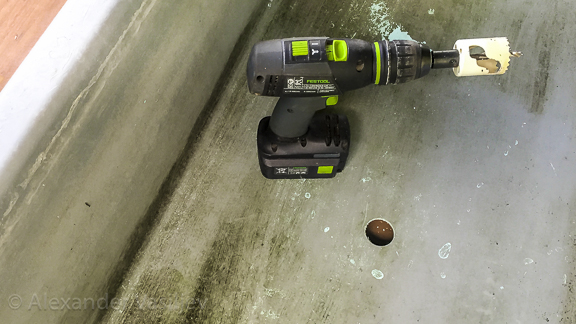
After the hole in the fiberglass pond was drilled, I fitted it with the bulkhead assembled with a brass coupler.
The garden hose was attached to the coupler underneath the pond and threaded through the hole left in the screened cage concrete header.
Finally, the moment I had been waiting for - to fill the pond with water and let the ranchu into their new home!
Here are a few comments and technical details. Due to under one inch (2.5 cm) garden hose diameter and less than two feet high gradient between the bottom of the pond and the draining ground, the time to empty the pond with its over 115 gal (435 l) of water is lengthy, about 45 to 50 min. But not a big trade off considering that the drain assembly is super simple, super reliable and very easy to fix. For my display pond I perform 100% water change every two weeks, as I still use bio filtration and a UV lamp.
On the other hand, to fill back the pond is a breeze. The water comes from the well and as soon as the pond is full the ranchu are in. No additional chemicals are used and the temperature of freshly pumped water is within 1-2 degrees of the water temperature in the tub. In addition, my well water is first pumped in to an aerator and gets infused with some oxygen, further I turn up the air pump during the filling. So far, I haven't noticed any visual distress when the ranchu enter fresh water. The deck and the pond are under the solid roof that deflects heat and protects from direct rain, and since the screened cage is opened on all three sides, there is a plenty of breeze to cool the summer heat. Water temperature stays below 83F (28C) even when the air temperature soars well above 90F (32C).
I have more improvements on the way and of course I have to start and finish the fishery, BY FEBRUARY! It is going to be a separate structure with a series of ponds and a culling station. But for now, I can take a short brake and enjoy my ranchu peacefully swimming in their new home! The new chapter has began!
Labels:goldfish, ranchu, TVR
DIY,
equipment,
Ranchu keeping,
Set up,
Tips,
Water quality
Subscribe to:
Posts (Atom)